Some thoughts about Google

miércoles, 25 de mayo de 2011 - Publicado por Manuel en 9:24
(This post is a short essay for the Master in Digital Business I´m enroled in, for the professor Enrique Dans)

What can be said about Google? Well, when a company becomes as ubiquitous and successful as the search engine one is, everyone has an opinion. Of course, each opinion will be slightly different, but on the overall, the majority of the Interweb users consider that Google is a really useful tool for surfing the Internet, including some people who consider that it is the Internet itself.


The Big Brother is watching you

Even if the strategy of continuous expansion and convergence (it is only a matter of time when Google launch its own telecom service) helped the company to reach its actual position, there are some challenges that the doodle has to face.

First of all, there are competitors. Always, especially on a channel where the switching costs are as low as they are online. Let´s imagine that next week a nerd in Silicon Valley announces a new search engine. Without ads, and which provided the best link the user was looking for as the first result. As the users started to talk about it, about how much better than Google it was. In a matter of years, maybe months, that engine would become the standard. And even if Google is not only a search engine, that is still its main source of revenues. And for a listed company, diminishing returns are always bad.

Another competitor of course, is Facebook. Being the website with the most time expent per user, FB is only a string of code away of developing a search engine of its own, thus offering its users a platform which there would be no need to leave. Never.

There is another issue concerning privacy. Even if Google always claims Net Neutrality and their own Neutrality when these problems arise, there could be a point when Google´s intention to get as much as information about the users, overcome the results that the users perceived. Voices would arise complaining about how scary Google is, and asking why Google have to take pictures of our houses, or file our MAC addresses. Maybe authorities would require Google to stop acquiring user data. And without information about our habits, Ad relevance would be much lower, so would be the company´s revenues.

Those would be the challenges Google has to face in the medium term. What about the long term?. Let´s project our minds 20 years in the future. The most feasible scenario would be an scenario where Internet connection is a universal right, where every single human is connected 24/7. Reached this point, governments would be the ones in charge of the infrastructure Internet required, or big telecom corporations. The challenge for Google then would be a physical one. Will Google have enough hardware support, and broadband, to provide every single human with the same services we are used to?. Considering the boom of cloud computing we are beholding these late years, I think this could be a big issue for a single company to handle.

Finally, the worst case scenario for Google. What if another platform, different than the Internet appears? A platform incompatible with the actual Net? Even though I think that Google´s actual main asset is their corporate culture, switching their whole exosystem to the new environment would be costly, maybe too much, and for sure it would require a time that other competitors could use to gain market share. 


Crowdrise, fundraising for the masses

Publicado por Manuel en 0:53
I would like to talk about an interesting web-based business I am analyzing. It´s called Crowdrise.


Crowdrise is a social network which covers an specific niche. Like Linkedin does with job connections, CR does so by connecting people with social concerns, and linking people involved in fundraising for humanitarian purposes with people who like to collaborate with their money. Crowdrise users can start their own fundraiser (even upload pictures and videos to make the project more real), join an existing fundraising team, appeal for support to friends and share their recent donations with a few simple clicks. By engaging in these activities, the users earn points, which can be translated into real prizes.More over, users are ranked and named depending on the points they have, which lead to a sort of  “humanitarian competition”.

Another point I really like is the touch of humor than the site has. It start with it´s logo, where a simple motto explains "if you don´t give back no one will like you" , and goes through every place, even in the FAQs, when it is stated that Crowdrise charges a 5% "Crowdrise's not wanting to go out of business fee" . Because CR it´s not an NGO, and they would like to get some bucks, which I think it´s fair considering the huge benefits this service can provide to the society. And they seem to be doing  a pretty good job, considering that there is an sustainable stream of donations, ranking from 5 to 150 $. 

Editor Vows George R. R. Martin Has Finished ‘A Dance With Dragons. A Publishin Industry analysis

martes, 24 de mayo de 2011 - Publicado por Manuel en 2:16

(This is an analysis for Master in Digital Business I´m enrolled in. Its quite long, so take it easy)


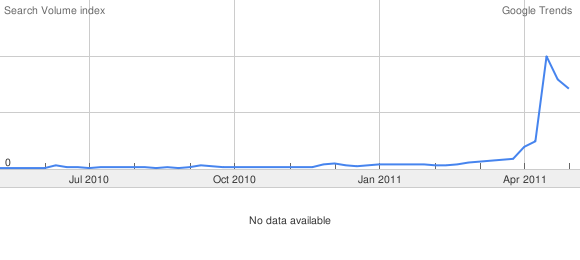
On April the 27th, and after more than 5 years of delay, George R.R. Martin, author of the lately famous A Song of Ice and Fire novels, announced that he had finished the writing of his fith novel based on the Seven Kingdoms, A Dance with Dragons. Moreover, his editor told that the book is wil be released in July the 12th. Martin used a more visual image to express it.

ASIF saga, has been around for awhile, with the first book released in 1996. However, even if it has been around for many years, only recently started to gain the mass attention.
The reason, of course, it´s HBO announcing last year their plan to release a ASIF TV Show, based on the first book, A Game of Thrones. Suddenly, a novel mainly known by Fantasy novels fans is now in everyone´s mouth.


As a personal comment,I recommend everyone to read the book before watching the show. The other way round does not work normally.Two days ago I had to explain to my father the first episode, and who was who. I felt really connected to him, like if finally we were sharing some of the “geek” stuff i had been doing for the past 15 years.

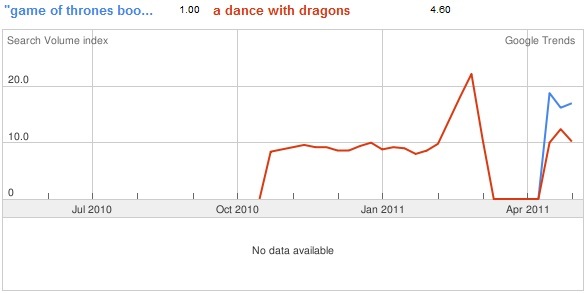
Of course, the added value of HBO content is that the sales of the book boomed, as people started to know it.
boo, stands for book btw.

I have no data to support this boost in GOT sales, but regarding my experience, ASIF is a saga marketed by word of mouth. I started to read because a friends told me it was amazing, and he lent it to me. And then i asked him for the other three books. Not only that, since then (i think it was 2003), I recommended it ti every friend i knew that liked this kind of novel.

I will now explain how the publishing industry works. Basically, you have the writer, the publisher, and the retailer. The talent, the “talent”, and the guy who sells it, in other words. More in depth:
-The writer is the one who has the idea, creates the content, and develop it to tell an story. Hopefully an interesting story, that people will pay to read.
-The publisher does all the post production, which turns the story into a book. The editor will get the writter in touch with experts on the field, will recommend the writer what works and what not, regarding his experience, market the product, choose the book format that fits the best with the book,print it, and negotiate with distributors /wholesalers for the best price. Normally they offer money in advance to the writer, so he can focus on writing, instead of other things, like paying the bills.
-Wholesalers/retailers (let`s call them distributors), basically move the product closer to the final customers, and keep them safe meanwhile.

About the revenue sharing model, as an example, for a book sold at 10$, retail will get 5$, 2$ goes for the publisher overheads, 1.5$ go to the author´s royalties, 1$ goes to paper and printing, and 50 cents is profit.

About the talent, as a writer comments, “Publishers aren´t doing it for the love of books”. This is business. So when a writer wants to sell a book to a publisher, first he has to think about who is going to buy it and why. So or either you are a famous author (or simply famous) and people want to read your next publication, or either you are writing about something that works, that already worked. Think about how many books synopsis start with “A secret society, has been keeping a secret for hundreds of years, but now, a doctor/detective/nerd discovered it, so they have to kill
him”. All of these similar books came out after Da Vinci Code was popular, and open a new trend (crappy fake-history books on this case). In this industry, “original” means “new”, and “new” means “risky. Specially if you have to print the copies before you know if the public will like the book.

As I told before, ASIF wasn´t known in its early years, even if it was honoured with many awards. It was Peter Jackson, and the Lord of The Rings movies, that made fantasy fiction mainstream. Many people that thought before fantasy was for nerds were now reading LOTR, Narnia Chronicles and so on.

About the value a publisher provides, it depends on who you are. If you are an unknown writer, to get the publisher´s support will help you a lot, with advice, contacts, and a good way to promote yourself and make you the next bestseller on the shelf. All for a piece of the pie of course (ranging 30% to 80% of the final price).
Self publishing is another option. By working with online publishers or printing the copies himself, the author can make as much as three times the benefit for the first 10,000 copies.
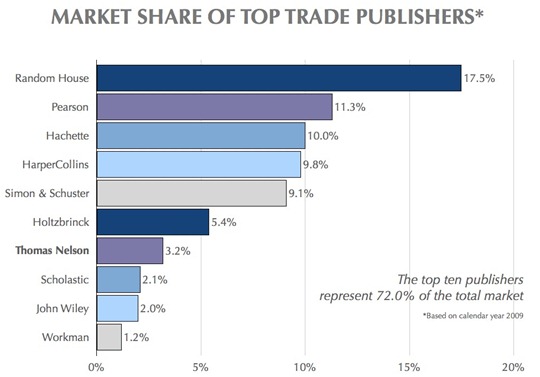
So for George R.R. Martin, as a famous writer he is nowadays, I see self publishing as an interesting option to consider. Readers will love to buy the next book in the Saga. Of course, there could be a problem, with Random House, the biggest English publisher and ASIF publisher going against George, trying to force the retailers to not have A Dance with Dragons on their shelves. But on this market, distributors have the final word, with Barnes & Noble making about 5 billion $ in sales every year, and Random House doing 2 billion $ (2007 data).

So RH is a big player, but publishing is a fragmented market, and RH  only has 18 % of the book market.
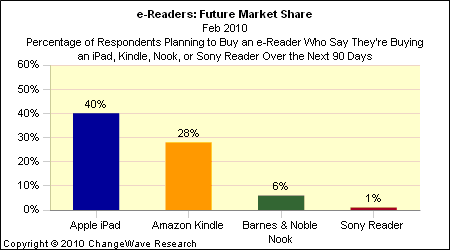
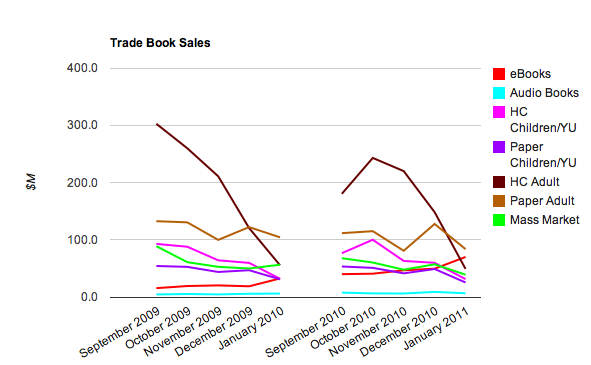
Apple and Amazon together are 70% of the ebook market. I guess they could survive with 20% of the books the sell.
And in this industry, electronic books are the only future. So George gets three times less as he could earn by self publishing himself. And as an experienced, bestseller writer, what is he obtaining now in return?. Not the writing advicing service, as I am sure that George will know better that his editor what fans like about his novels. Fans write him everyday, through email or his blog. Not the Public relations, because George does that on his own blog online everyday. About the agreements with retailers, that just a matter of numbers. Even if George sold his book in electronic format on his website, it would be a success, because people is actively looking for it. An smaller success for sure, but much more profitable for him.

PlayStation Network hack, down time may cost Sony billions

Publicado por Manuel en 2:13

As you may know, Sony Playstation Network, the online platform providing services to the Playstation 3 users, suffered an attack by a group of hackers a month ago (Whether the hacktivist group Anonymous was involved or not its argueable). A group of hackers managed to get access to PS users database, obtaining data from almost 10 million users, credit card information, cvv codes and more. The story went on , with users from underground forums offering these databases for sale, arguing that Sony did not want to buy it.It seemed that the servers Sony was using were not updated, and there was no firewall to block incoming connections. Even my wi-fi connection seems to be safer.


Yesterday, Sony announced that the Playstation Network may not be fully back till May the 31st, and analysts estimated a loss for Sony of £758.8millions. That £ means  British pounds, by the way.

So basically, we have a system when a company, Sony, owns the physical platform (hardware) for videogames, and the online platform (channel), the Playstation Store, where PS3 owners can buy games and Downloadable content (DLC)  for their Blue Ray videogames. All paid in cash of course. There is a trend in game developing to offer games at lower prices, and then add extra features as DLC that the user can purchase. This way the streams of revenue for both Sony and publishers increase, mainly because these DLC are all in digital format, with almost no cost attached. I tried to find the P&L for Playstation, but with no success.

So a disruption on the only channel publishers can sell their addons for their games, is hurting them. On an industry mainly based on time to market, where a delay on a videogame can make the company behind it loose money (ask why most of the releases are before Christmas, or better, ask 3D Realms what happened with Duke Nukem Forever)

As an example, Activision was about to release an addon for their most succesful game, Call of Duty: Black Ops. And the delay is making them millionaire losses. The same for Capcom. I hope the publishers are not using this as an excuse to sue Sony and get some millions back, at the traditional US style.
In my humble opinion, its not a big deal if publishers loose some bucks. Its not like they had many other choices to sell their products, specially now that most of them provide almost the same videogame to both platforms, XBOX 360 and PS3. The big problem, and that is unavoidable, is that this problem will cause a big damage to the trust users had on the PSN, and in the beginning of the 21st century, online payments are not perceived as reliable as real cash deals. This could make Playstation to loose many potential new users of their platform, or make actual users beware of purchasing content online. Moreover, if the credit card database starts to spread, Sony would be reliable for all the losses the users face. The nightmare for Sony has only started.

Hello World

Publicado por Manuel en 1:29
Lorem ipsum dolor sit amet, consectetuer adipiscing elit, sed diam nonummy nibh euismod tincidunt ut laoreet dolore magna aliquam erat volutpat. Ut wisi enim ad minim veniam, quis nostrud exerci tation ullamcorper suscipit lobortis nisl ut aliquip ex ea commodo consequat. Duis autem vel eum iriure dolor in hendrerit in vulputate velit esse molestie consequat, vel illum dolore eu feugiat nulla facilisis at vero eros et accumsan et iusto odio dignissim qui blandit praesent luptatum zzril delenit augue duis dolore te feugait nulla facilisi. Nam liber tempor cum soluta nobis eleifend option congue nihil imperdiet doming id quod mazim placerat facer possim assum. Typi non habent claritatem insitam; est usus legentis in iis qui facit eorum claritatem. Investigationes demonstraverunt lectores legere me lius quod ii legunt saepius. Claritas est etiam processus dynamicus, qui sequitur mutationem consuetudium lectorum. Mirum est notare quam littera gothica, quam nunc putamus parum claram, anteposuerit litterarum formas humanitatis per seacula quarta decima et quinta decima. Eodem modo typi, qui nunc nobis videntur parum clari, fiant sollemnes in futurum.